All Categories
Featured
Table of Contents
Track and monitor your evaluations against up to 5 competitors to better understand where you stand in the market. Automate your reporting with natural language sentiment analysis tools to assist you uncover crucial themes of your reviews to make impactful changes that matter to your consumer base.
Evaluation monitoring is just offered on their highest-paid plan. Many SaaS organizations, especially smaller sized ones, might not need the majority of functions it offers and may be better off picking a more targeted tool for review monitoring and management alone.: 4.4: $76/ month.
Riyadh’s Fintech Surge: Balancing Innovation with Financial StabilityAutomation has become the backbone of company efficiency, but in 2026, it has to do with more than simply saving time. The brand-new generation of automation platforms are progressing from isolated task automation to end-to-end orchestration, where systems, people, and data run in sync. As the automation landscape diversifies, five platforms stand out for their distinct strengths: leads in unifying information and workflow automation throughout both business and IT groups, while deals task-based workflow capabilities.
Together, these tools highlight how the market is progressing from isolated job automation to intelligent, scalable orchestration. For operations and IT leaders, the best platform can mean the difference in between fragmented workflows and a seamlessly connected enterprise. This guide checks out the very best automation platforms for 2026, how they're reshaping digital transformation, and what to look for as automation develops into intelligent orchestration.

Rather of counting on customized scripts or manual information entry, automation platforms utilize visual builders, prebuilt connectors, and APIs to merge business operations. While some platforms focus on organization process automation, such as marketing or HR, others focus on central IT, making sure dependability and control over complex system architectures and mission-critical processes.
How GCC Startups Disrupt Innovation in 2026
IT and integration designers count on these platforms to handle data circulation, implement governance, and preserve performance throughout systems. Celigo's Intelligent Automation Platform bridges these 2 worlds. By combining low-code workflow style with enterprise-grade governance, Celigo enables federated access to automation, where business users and technical groups can build and handle the automations they understand best, all under the best guardrails that put IT's mind at ease.
From startups to global enterprises, organizations are purchasing platforms that combine versatility with control. Here's why: Automation eliminates manual actions and the need to compose custom-made integration scripts, releasing groups to concentrate on higher-impact work. Whether it's syncing CRM information, routing tickets, or automating financial close processes, automation programs help in reducing cycle times and increase throughput without extra headcount.
Automation platforms ensure information reliability by imposing guidelines and recognitions throughout connected systems, improving reporting accuracy and compliance. Connecting detached systems with unified orchestration assists companies scale efficiently. Rather of building customized scripts or straining people with manual information entry, automation platforms act as a central center, decreasing integration costs and operational overhead while enhancing data quality and efficiency.
The days of automation requiring innovative coding are over. The leading platforms empower non-technical users to produce, test, and release automations through visual, drag-and-drop user interfaces, while providing IT groups the ability to handle and keep an eye on those workflows centrally.
Riyadh’s Fintech Surge: Balancing Innovation with Financial StabilityStrategic AI Innovation for 2026 Enterprises
The very best platforms provide prebuilt adapters, universal REST/HTTP API compatibility, and event-driven workflows that make it basic to manage data flow throughout your environment. As automation scales, so does the requirement for control. Enterprise-grade platforms supply governance tools, audit tracks, and mistake monitoring that guarantee every automation runs firmly, with presence across every workflow.
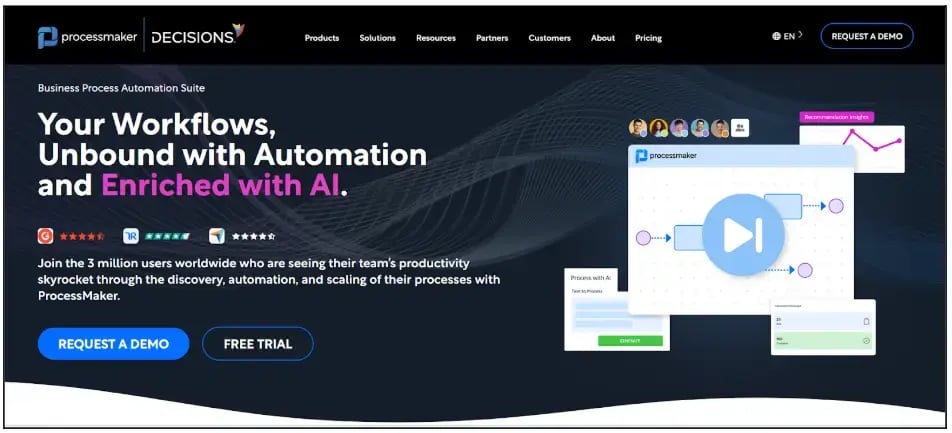
For IT designers, they offer guarantee around SLAs, workflow performance, data security, and compliance. A modern automation platform ought to handle all workflows in one location moving information between apps, linking partners, managing APIs, and supporting AI-driven tasks. With a single, easy-to-use user interface, IT and business groups can see issues, fix them quick, and avoid handling multiple integration tools.
In the age of AI, automation platforms are the backbone that provides AI protect access to business data, collaborates numerous agents, and guarantees the oversight IT needs. The strongest platforms let teams integrate clear, rule-based steps with AI-driven tasks, picking the right level of autonomy for each workflow. Just as significantly, they run all of these workflows together in one environment, making it much easier to orchestrate and handle them throughout business.
Below are a few of the top competitors shaping the automation landscape in 2026. Best for combined business and IT automation Celigo's Intelligent Automation Platform brings structure, operating, and scaling automation into one unified system. Technical teams get the power and speed they need, while company users can quickly contribute using AI-assisted style and prebuilt components.

Latest Posts
The Future of Technological Innovation for Startups
New Venture Updates From GCC Startup Sector
Strategic Benefits of Cloud Integration in the GCC