All Categories
Featured
For its part, the U.S. Department of Justice describes that the CLOUD Act has made it possible for bilateral executive arrangements to assist in access to information in cases involving "severe criminal activities," within safeguards to secure rights. By contrast, companies such as AWS Offer a defensive analysis relating to personal privacy, with Amazon stating there is "no automated access to data," and mentioning that it has not disclosed the material of government/institutional consumers kept outside the United States to the U.S.
Around 35% of cloud service centers in the region belong area American companies, totaling 31 centers, while Chinese-owned centers account for about 8%, with 7. Iran, meanwhile, relies completely on four domestic companies, offering it 100% regional cloud facilities. Overall, 42% of the region's cloud services are provided by regional or numerous multinational companies.
Overall, every Gulf nation has a U.S. cloud presence. Iran: The cloud environment is effectively localized.

Boosting ROI in Advanced AI Systems
sanctions. Majority of the cloud deployments in the area (51%) were introduced after 2020, with 46 centers out of a total of 89 developed during that duration. 89 centers each nationality's share of total existences Variety of presences/centers in the area Overall cloud existences per nation Declared service type/sector Show the comprehensive table for all centers (89 centers) #CountryLocationCenter nameOperatorNationalityOwnerYearClassificationCoverageAZ The examination concentrated on studying all cloud service centers in the Middle East and North Africa area, throughout their three classifications in regards to size and capability to provide services: All hyperscaler centers are operated by global business such as AWS, Azure, Google, and Oracle, many of which are situated in the Gulf states and "Israel." Other countries save their information in city government data centers or regional telecom-company information centers, which fall within the second and third tiers of the categories.
In cases of dispute or sanctionsas in Syria and Yemenbarriers increase since of compliance limitations and damage to facilities. Cloud computing services are a design that makes it possible for "on-demand" access to shared computing resources (networks, servers, storage, applications, and services) that can be quickly provisioned and launched with very little administrative effort.
a number of separate sites/data centers within the area, developed to lower single points of failure, with separation in power, cooling, physical security, and low-latency network connectivity. There are also layers of cloud services or service shipment models (IaaS/PaaS/SaaS) and release and use models (public/private/hybrid/ community), which are a vital part of understanding and evaluating threats and sovereignty over cloud service centers in the nations that host them.
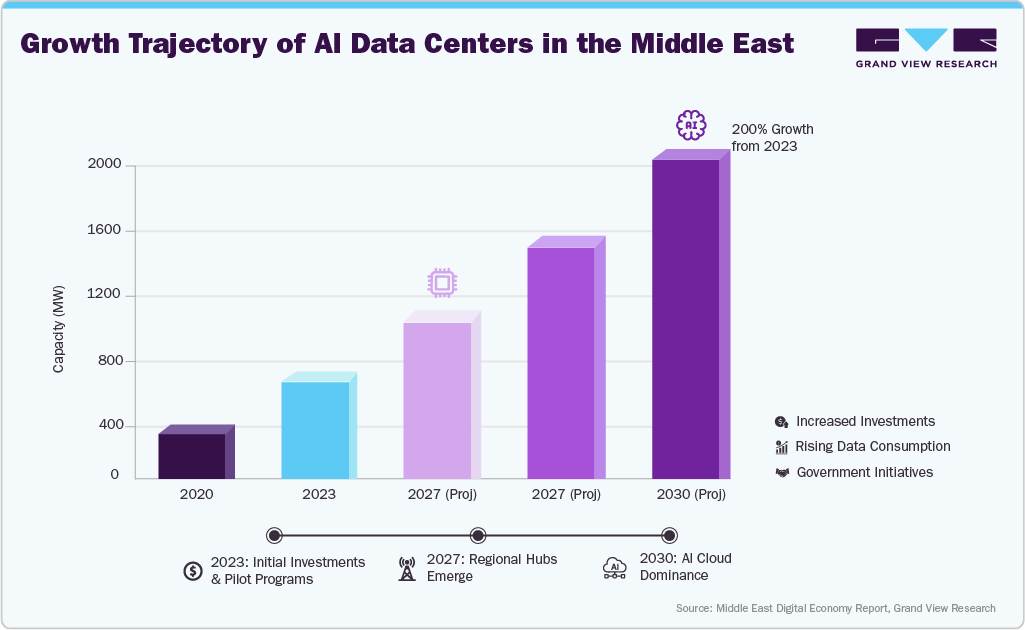
Information analytics and artificial intelligence: cloud centers provide enormous computing and storage capacity to run data analytics for states and federal governments, maker knowing, and AI work that need specialized and massive hardware. This, for instance, is one reason behind the race by data centers and AI to develop a presence in the Gulf and supply services there.
Ways to Create Roadmaps for AI in 2026
This is the reasoning behind designing schedule zones within an area, or across numerous areas when laws allow. The kind of cloud service utilize depends on each nation's policy and its data category, but the most common patterns in the general public sector consist of: personal data, documents, residency records. taxes, custom-mades, and government procurement.
the Internet of Things, picking up, traffic, energy/water. frequently greatly restricted and isolated, or special/sovereign environments are constructed for it depending on classification level of sensitivity. This is where the significance of release models (private/hybrid cloud)ends up being clear: lots of governments tend toward a hybrid approachpartly on a public cloud for less sensitive workloads, and partly on a private/sovereign cloud for more delicate ones. The RUSI research study institute says that the targeting of information centers in the Gulf on March 1, 2026 produced worldwide doubts about the strength, sovereignty, security, and fragility of these centers, keeping in mind that data centers might be treated as strategic properties and "vital facilities,"especially if they are thought to support defense/intelligence capabilities alongside civilian services. The threat is not simply"losing files,"but digitally disabling and paralyzing states. It can be summarized in 5 points: Vital service interruptions (Schedule Shock): If banks, payments, civil service platforms, or significant companies depend upon the affected area, the interruption rapidly affects the public and the economy. RUSI pointed to broader interruption to financial and consumer services after the Gulf strikes. Fragility in the face of non-cloud bottlenecks: Even if information centers are not bombed, submarine cables and globalconnection can trigger severe congestion/degradation in cloud services. Example: cuts to cable televisions in the Red Sea impacted Azure routes and increased latency in South Asia and the Gulf. The cloud services industry represents a substantial worldwide market, and costs on it is gradually increasing every year with the advancement and growth of artificial intelligence services. Regionally, Gartner, the research, consulting, and info technology firm, anticipates IT spending in the Middle East and North Africa to reach 169 billion dollars in 2026, and specifies that" data center systems"are the fastest-growing market, approximated at 12.984 billion dollars in 2026. McKinsey, meanwhile, explains public cloud centers in the Middle East as a"multibillion-dollar chance" connected to digital improvement and onethat is extremely scalable. This is either since they are variable consumption-based contracts, structure contracts, or part of wider procurement portfolios (digital improvement)that are not publicly detailed. The following can be recognized: According to a news report released by Arab News in 2015, the value of government agreements in the ICT(Info and Communications Technology)sector reached SAR 38 billion in 2024(approximately US$ 10.13 billion), with a concentrate on cloud computing and synthetic intelligence as top priorities. In 2024, Amazon revealed the construction of 2 cloud areas in Saudi Arabia at an expense exceeding US$ 5.3 billion. In the very same year, Oracle Revealed the launch of a 2nd public cloud area in Saudi Arabia to "strengthen the AI economy,"with a financial investment of US$ 1.5 billion. In March 2025, the Abu Dhabi government revealed its goal of automating 100 %of federal government operations, supported by an investment of approximately AED 13 billion(US$ 3.54 billion)in digital infrastructure under the Digital Method 20252027, together with sovereign cloud agreements with Microsoft and Core42. In November 2025, the state-owned company qnbn revealed the finalizing of a multi-year contract with Microsoft to provide cloud computing services aimed at"accelerating digital change and expert system,"though the agreement's value was not revealed.

Latest Posts
The Future of Technological Innovation for Startups
New Venture Updates From GCC Startup Sector
Strategic Benefits of Cloud Integration in the GCC